​a Cidr Block of /26 Is Equivalent to What Subnet Mask Below?

As a programmer or network engineer, you lot may need to occasionally wait upward subnet mask values and figure out what they mean.
To make your life easier, the freeCodeCamp community has made this simple cheat sheet. Just scroll or use Ctrl/Cmd + f to notice the value you're looking for.
Hither are the charts, followed by some explanations of what they mean.
| CIDR | Subnet mask | Wildcard mask | # of IP addresses | # of usable IP addresses |
|---|---|---|---|---|
| /32 | 255.255.255.255 | 0.0.0.0 | 1 | 1 |
| /31 | 255.255.255.254 | 0.0.0.1 | 2 | two* |
| /30 | 255.255.255.252 | 0.0.0.three | 4 | 2 |
| /29 | 255.255.255.248 | 0.0.0.vii | 8 | 6 |
| /28 | 255.255.255.240 | 0.0.0.15 | xvi | fourteen |
| /27 | 255.255.255.224 | 0.0.0.31 | 32 | 30 |
| /26 | 255.255.255.192 | 0.0.0.63 | 64 | 62 |
| /25 | 255.255.255.128 | 0.0.0.127 | 128 | 126 |
| /24 | 255.255.255.0 | 0.0.0.255 | 256 | 254 |
| /23 | 255.255.254.0 | 0.0.1.255 | 512 | 510 |
| /22 | 255.255.252.0 | 0.0.3.255 | 1,024 | 1,022 |
| /21 | 255.255.248.0 | 0.0.seven.255 | two,048 | 2,046 |
| /20 | 255.255.240.0 | 0.0.15.255 | 4,096 | four,094 |
| /19 | 255.255.224.0 | 0.0.31.255 | 8,192 | 8,190 |
| /18 | 255.255.192.0 | 0.0.63.255 | 16,384 | 16,382 |
| /17 | 255.255.128.0 | 0.0.127.255 | 32,768 | 32,766 |
| /sixteen | 255.255.0.0 | 0.0.255.255 | 65,536 | 65,534 |
| /15 | 255.254.0.0 | 0.1.255.255 | 131,072 | 131,070 |
| /14 | 255.252.0.0 | 0.iii.255.255 | 262,144 | 262,142 |
| /thirteen | 255.248.0.0 | 0.7.255.255 | 524,288 | 524,286 |
| /12 | 255.240.0.0 | 0.xv.255.255 | i,048,576 | 1,048,574 |
| /11 | 255.224.0.0 | 0.31.255.255 | ii,097,152 | 2,097,150 |
| /10 | 255.192.0.0 | 0.63.255.255 | 4,194,304 | 4,194,302 |
| /9 | 255.128.0.0 | 0.127.255.255 | 8,388,608 | 8,388,606 |
| /eight | 255.0.0.0 | 0.255.255.255 | 16,777,216 | 16,777,214 |
| /vii | 254.0.0.0 | 1.255.255.255 | 33,554,432 | 33,554,430 |
| /6 | 252.0.0.0 | 3.255.255.255 | 67,108,864 | 67,108,862 |
| /five | 248.0.0.0 | 7.255.255.255 | 134,217,728 | 134,217,726 |
| /iv | 240.0.0.0 | 15.255.255.255 | 268,435,456 | 268,435,454 |
| /iii | 224.0.0.0 | 31.255.255.255 | 536,870,912 | 536,870,910 |
| /2 | 192.0.0.0 | 63.255.255.255 | 1,073,741,824 | 1,073,741,822 |
| /1 | 128.0.0.0 | 127.255.255.255 | 2,147,483,648 | two,147,483,646 |
| /0 | 0.0.0.0 | 255.255.255.255 | 4,294,967,296 | four,294,967,294 |
* /31 is a special case detailed in RFC 3021 where networks with this type of subnet mask can assign two IP addresses equally a bespeak-to-point link.
And here's a table of the decimal to binary conversions for subnet mask and wildcard octets:
| Subnet Mask | Wildcard | ||
|---|---|---|---|
| 0 | 00000000 | 255 | 11111111 |
| 128 | 10000000 | 127 | 01111111 |
| 192 | 11000000 | 63 | 00111111 |
| 224 | 11100000 | 31 | 00011111 |
| 240 | 11110000 | 15 | 00001111 |
| 248 | 11111000 | 7 | 00000111 |
| 252 | 11111100 | 3 | 00000011 |
| 254 | 11111110 | 1 | 00000001 |
| 255 | 11111111 | 0 | 00000000 |
Note that the wildcard is just the inverse of the subnet mask.
If yous are new to network engineering, y'all tin become a better idea of how estimator networks work here.
Finally, this cheat canvass and the rest of the commodity is focused on IPv4 addresses, not the newer IPv6 protocol. If you'd like to larn more about IPv6, check out the article on calculator networks above.
How Do IP Address Blocks Work?
IPv4 addresses like 192.168.0.1 are really just decimal representations of four binary blocks.
Each cake is 8 bits, and represents numbers from 0-255. Because the blocks are groups of 8 bits, each cake is known equally an octet. And since at that place are 4 blocks of 8 $.25, every IPv4 accost is 32 bits.
For example, here's what the IP address 172.16.254.1 looks like in binary:

To convert an IP address between its decimal and binary forms, you lot tin use this chart:
| 128 | 64 | 32 | xvi | 8 | 4 | 2 | ane |
|---|---|---|---|---|---|---|---|
| x | x | x | 10 | x | ten | x | x |
The chart to a higher place represents one eight bit octive.
Now lets say you want to convert the IP address 168.210.225.206. All yous demand to practice is break the accost into 4 blocks (168, 210, 225, and 206), and convert each into binary using the chart higher up.
Recall that in binary, 1 is the equivalent to "on" and 0 is "off". So to convert the kickoff cake, 168, into binary, just starting time from the beginning of the chart and place a 1 or 0 in that cell until you become a sum of 168.
For instance:
| 128 | 64 | 32 | 16 | 8 | 4 | two | i |
|---|---|---|---|---|---|---|---|
| 1 | 0 | 1 | 0 | ane | 0 | 0 | 0 |
128 + 32 + eight = 168, which in binary is 10101000.
If y'all practise this for the residue of the blocks, you'd go 10101000.11010010.11100001.11001110.
What is Subnetting?
If yous look at the tabular array above, it tin seem like the number of IP addresses is practically unlimited. After all, in that location are almost four.2 billion possible IPv4 addresses available.
Simply if yous think about how much the internet has grown, and how many more devices are connected these days, information technology might not surprise you to hear that there'due south already a shortage of IPv4 addresses.
Because the shortage was recognized years ago, developers came upwards with a way to split up upward an IP accost into smaller networks called subnets.
This procedure, called subnetting, uses the host section of the IP address to break it downwards into those smaller networks or subnets.
Generally, an IP address is made up of network bits and host $.25:
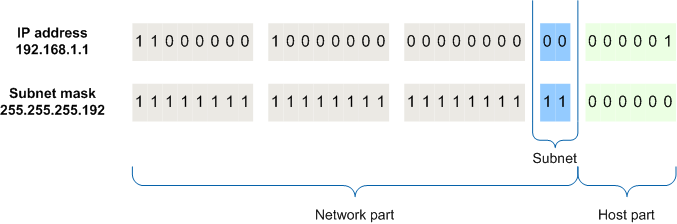
And then generally, subnetting does two things: information technology gives us a way to break up networks into subnets, and allows devices to decide whether another device/IP address is on the same local network or not.
A good style to call back about subnetting is to picture your wireless network at dwelling house.
Without subnetting, every internet continued device would demand its own unique IP address.
But since you take a wireless router, yous merely need one IP address for your router. This public or external IP address is unremarkably handled automatically, and is assigned by your internet service provider (ISP).
Then every device connected to that router has its ain private or internal IP accost:
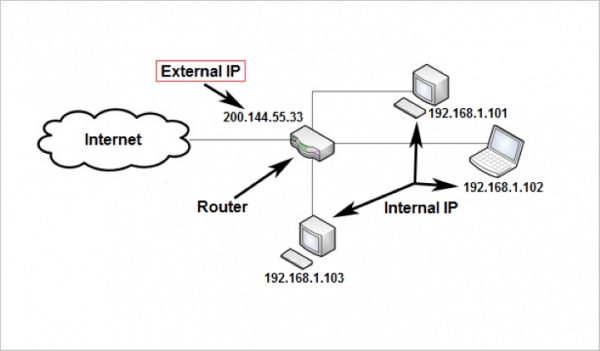
Now if your device with the internal IP address 192.168.one.101 wants to communicate with another device, information technology'll use the IP address of the other device and the subnet mask.
The combination of the IP addresses and subnet mask allows the device at 192.168.1.101 to figure out if the other device is on the same network (like the device at 192.168.ane.103), or on a completely different network somewhere else online.
Interestingly, the external IP address assigned to your router past your ISP is probably part of a subnet, which might include many other IP addresses for nearby homes or businesses. And merely like internal IP addresses, information technology also needs a subnet mask to work.
How Subnet Masks Work
Subnet masks part as a sort of filter for an IP address. With a subnet mask, devices tin can wait at an IP address, and figure out which parts are the network bits and which are the host $.25.
Then using those things, it tin figure out the best way for those devices to communicate.
If you've poked around the network settings on your router or reckoner, y'all've likely seen this number: 255.255.255.0.
If so, you lot've seen a very common subnet mask for simple habitation networks.
Like IPv4 addresses, subnet masks are 32 bits. And just like converting an IP address into binary, you can do the same matter with a subnet mask.
For example, here's our chart from before:
| 128 | 64 | 32 | 16 | 8 | iv | 2 | 1 |
|---|---|---|---|---|---|---|---|
| x | ten | x | 10 | x | x | 10 | x |
At present allow'south convert the outset octet, 255:
| 128 | 64 | 32 | 16 | 8 | 4 | 2 | 1 |
|---|---|---|---|---|---|---|---|
| 1 | 1 | ane | ane | 1 | 1 | ane | 1 |
Pretty elementary, right? So any octet that's 255 is just 11111111 in binary. This ways that 255.255.255.0 is really 11111111.11111111.11111111.00000000 in binary.
Now permit's look at a subnet mask and IP address together and calculate which parts of the IP address are the network $.25 and host bits.
Here are the 2 in both decimal and binary:
| Blazon | Decimal | Binary |
|---|---|---|
| IP address | 192.168.0.101 | 11000000.10101000.00000000.01100101 |
| Subnet mask | 255.255.255.0 | 11111111.11111111.11111111.00000000 |
With the 2 laid out like this, it'south easy to split 192.168.0.101 into network $.25 and host $.25.
Whenever a scrap in a binary subnet mask is 1, then the same chip in a binary IP address is function of the network, not the host.
Since the octet 255 is 11111111 in binary, that whole octet in the IP accost is function of the network. And then the first three octets, 192.168.0, is the network portion of the IP accost, and 101 is the host portion.
In other words, if the device at 192.168.0.101 wants to communicate with some other device, using the subnet mask information technology knows that anything with the IP address 192.168.0.xxx is on the aforementioned local network.
Another way to limited this is with a network ID, which is just the network portion of the IP address. So the network ID of the address 192.168.0.101 with a subnet mask of 255.255.255.0 is 192.168.0.0.
And it's the same for the other devices on the local network (192.168.0.102, 192.168.0.103, so on).
What Does CIDR Hateful and What is CIDR Notation?
CIDR stands for Classless Inter-Domain Routing, and is used in IPv4, and more than recently, IPv6 routing.
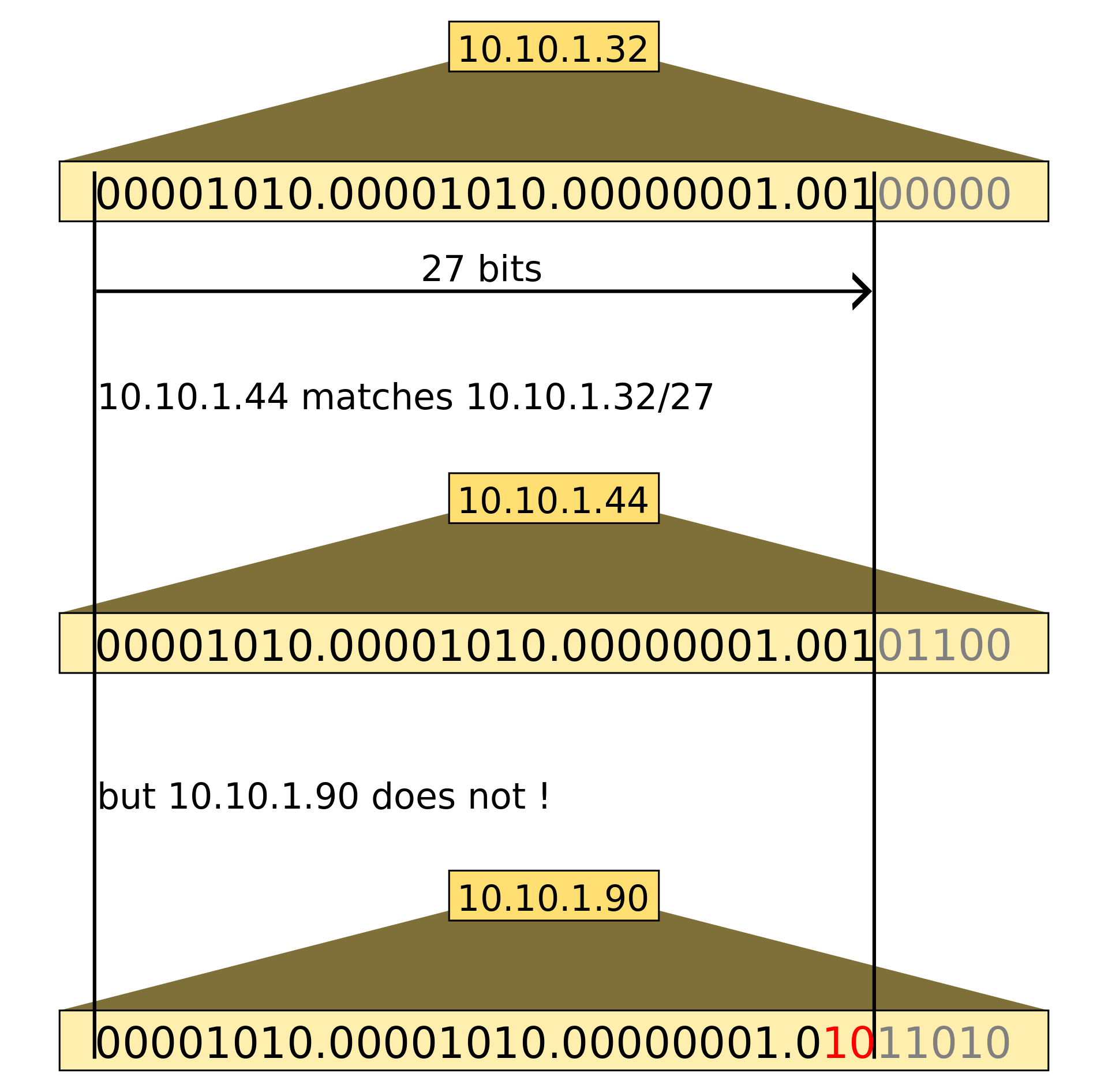
CIDR was introduced in 1993 equally a style to tiresome the usage of IPv4 addresses, which were speedily existence wearied under the older Classful IP addressing organisation that the internet was start built on.
CIDR encompasses a couple of major concepts.
The first is Variable Length Submasking (VLSM), which basically allowed network engineers to create subnets within subnets. And those subnets could be different sizes, and so at that place would exist fewer unused IP addresses.
The 2nd major concept CIDR introduced is CIDR notation.
CIDR annotation is really just autograph for the subnet mask, and represents the number of bits available to the IP address. For instance, the /24 in 192.168.0.101/24 is equivalent to the IP address 192.168.0.101 and the subnet mask 255.255.255.0.
How to Calculate CIDR Noation
To figure out the CIDR note for a given subnet mask, all y'all demand to do is catechumen the subnet mask into binary, and so count the number of ones or "on" digits. For example:
| Type | Decimal | Binary |
|---|---|---|
| Subnet mask | 255.255.255.0 | 11111111.11111111.11111111.00000000 |
Considering there's 3 octets of ones, there are 24 "on" $.25 significant that the CIDR notation is /24.
You can write it either manner, just I'm certain yous'll agree that /24 is a whole lot easier to write than 255.255.255.0.
This is usually done with an IP address, so let's accept a look at the same subnet mask with an IP accost:
| Type | Decimal | Binary |
|---|---|---|
| IP address | 192.168.0.101 | 11000000.10101000.00000000.01100101 |
| Subnet mask | 255.255.255.0 | 11111111.11111111.11111111.00000000 |
The first 3 octets of the subnet mask are all "on" bits, so that means that the same three octets in the IP accost are all network bits.
Permit's take a look at the terminal along octet in a bit more item:
| Blazon | Decimal | Binary |
|---|---|---|
| IP accost | 101 | 01100101 |
| Subnet mask | 0 | 00000000 |
In this case, considering all the bits for this octet in the subnet mask are "off", we can be certain that all of the respective bits for this octet in the IP address are part of the host.
When you write CIDR annotation it'due south usually done with the network ID. And so the CIDR notation of the IP address 192.168.0.101 with a subnet mask of 255.255.255.0 is 192.168.0.0/24.
To meet more than examples of how to summate the CIDR notation and network ID for a given IP address and subnet mask, check out this video:
Classful IP Addressing
Now that we've gone over some basic examples of subnetting and CIDR, permit's zoom out and expect at what'south known as Classful IP addressing.
Back before subnetting was developed, all IP addresses barbarous into a item class:
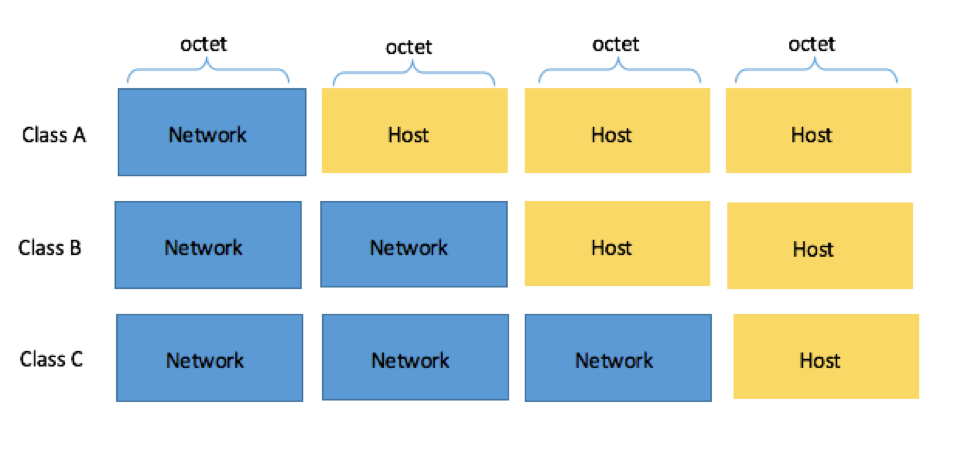
Note that in that location are class D and Eastward IP addresses, but we'll become into these in more particular a bit subsequently.
Classful IP addresses gave network engineers a manner to provide different organizations with a range of valid IP addresses.
There were a lot of bug with this arroyo that somewhen pb to subnetting. Merely before we go into those, let's accept a closer wait at the different classes.
Class A IP Addresses
For Form A IP addresses, the kickoff octet (eight bits / ane byte) represent the network ID, and the remaining three octets (24 $.25 / 3 bytes) are the host ID.
Class A IP addresses range from 1.0.0.0 to 127.255.255.255, with a default mask of 255.0.0.0 (or /8 in CIDR).
This means that Class A addressing can have a total of 128 (27) networks and 16,777,214 (224-2) usable addresses per network.
Also, note that the range 127.0.0.0 to 127.255.255.255 within the Grade A range is reserved for host loopback accost (see RFC5735).
Class B IP Addresses
For Grade B IP addresses, the outset 2 octets (16 bits / 2 bytes) stand for the network ID and the remaining ii octets (16 bits / 2 bytes) are the host ID.
Class B IP addresses range from 128.0.0.0 to 191.255.255.255, with a default subnet mask of 255.255.0.0 (or /sixteen in CIDR).
Class B addressing tin have 16,384 (214) network addresses and 65,534 (2xvi) usable addresses per network.
Class C IP Addresses
For Class C IP addresses, the first iii octets (24 bits / iii bytes) represent the network ID and the last octet (8 bits / 1 bytes) is the host ID.
Class C IP Addresses range from 192.0.0.0 to 223.255.255.255, with a default subnet mask of 255.255.255.0 (or /24 in CIDR).
Grade C translates to 2,097,152 (221) networks and 254 (28-2) usable addresses per network.
Form D and Course E IP Addresses
The final two classes are Form D and Class E.
Class D IP addresses are reserved for multicasts. They occupy the range from 224.0.0.0 through 239.255.255.255.
Class E IP addresses are experimental, and are anything over 240.0.0.0.
The Issue with Classful IP Addresses
The main effect with classful IP addresses is that it wasn't efficient, and could lead to a lot of wasted IP addresses.
For example, imagine that you're part of a large organization back and so. Your company has ane,000 employees, meaning that it would fall into grade B.
Only if you await above, y'all'll run across that a class B network tin can support upwardly to 65,534 usable addresses. That's way more than your system would likely need, even if each employee had multiple devices with a unique accost.
And there was no mode your organization could fall dorsum to class C – there just wouldn't exist enough usable IP addresses.
So while classful IP addresses were used around the time IPv4 addresses became widespread, it quickly became articulate that a ameliorate system would be necessary to ensure nosotros wouldn't utilise up all of the ~iv.two billion usable addresses.
Classful IP addresses haven't been used since they were replaced by CIDR in 1993, and are mostly studied to understand early internet architecture, and why subnetting is important.
I hope this cheat sail has been a helpful reference for you
If yous constitute this helpful, delight share information technology with your friends so more people can do good from it.
Also, feel free to reach out on Twitter and let me know what y'all think.
Larn to lawmaking for costless. freeCodeCamp's open source curriculum has helped more than xl,000 people get jobs as developers. Get started
Source: https://www.freecodecamp.org/news/subnet-cheat-sheet-24-subnet-mask-30-26-27-29-and-other-ip-address-cidr-network-references/
0 Response to "​a Cidr Block of /26 Is Equivalent to What Subnet Mask Below?"
Post a Comment