Stepper Motor Starts Then Stops Then Starts Again
Stepper motors enable accurate positioning with ease. They are used in diverse types of equipment for accurate rotation angle and speed control using pulse signals. Stepper motors generate high torque with a compact trunk, and are platonic for quick acceleration and response. Stepper motors also concord their position at stop, due to their mechanical blueprint. Stepper motor solutions consist of a driver (takes pulse signals in and converts them to motor motion) and a stepper motor.
Oriental Motor offers many solutions for a wide diversity of applications:
- AlphaStep Closed Loop Stepper Motors, 2-Phase Stepper Motors, 5-Phase Stepper Motors
- Geared, Encoder and Electromagnetic Brake options
- Air-conditioning or DC Input Stepper Motor Drivers
- Frame Sizes from 0.79 in. (twenty mm) upwardly to 3.54 in. (90 mm)
Read more...
- Stepper Motors (Motor Only)
- Stepper Motor Drivers
- Speed Control Stepper Motors
- Controllers
Stepper Motors (Motor Only)
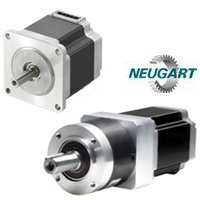
Oriental Motor offers a wide range of stepper motors including; AlphaStep airtight loop stepper motors, 2-stage stepper motors and v-phase stepper motors available in frame sizes from 0.79 in. (20 mm) up to 3.54 in. (ninety mm). Five geared type stepper motor solutions, encoder and restriction options and various motor windings are offered.
- 0.79 in. ~ 3.54 in. (twenty mm~ xc mm) NEMA 8 ~ NEMA 34 frame size stepper motors
- Non-backlash, Low-backlash and Spur Gears available
- AlphaStep Closed Loop Stepper Motors, 2-Phase Stepper Motors and five-Phase Stepper Motors
- Encoder and Electromagnetic Restriction Options
- Learn More
- Shop Online
- Search by Specification
- α Step Closed Loop Stepper Motors
- 2-Phase Stepper Motors
- 5-Stage Stepper Motors
Stepper Motor Drivers
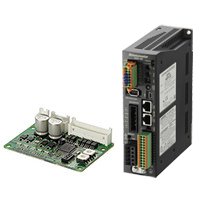
EtherNet/IP™ is a trademark of ODVA
Speed Control Stepper Motors & Drivers
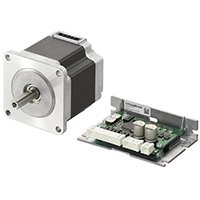
The CVK Series SC speed control system offers a simple configuration consisting of a stepper motor, driver and programmable controller. The operating speed, acceleration and deceleration time, running current can be prepare via the driver switches, and simply turning the FWD (RVS) input to ON or OFF allows for easy control.
- No pulse generator needed
- 2 speed settings are possible
- Compact and loftier torque stepper motor
- Acquire More
- Store Online
- Search by Specification
Controllers / Network Gateways
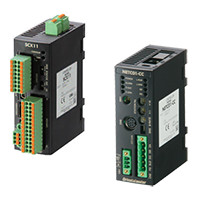
Controllers and Network Gateways for use with motion command systems.
- Controllers for use with Pulse Input Drivers
- Network Converters/Gateways (RS-485 Advice)
- EtherCat
- CC-Link
- MECHATROLINK



- Larn More
- Shop Online
- Controllers
- Network Gateways
Stepper Motors & Drivers
A stepper motor is used to achieve precise positioning via digital control. The motor operates by accurately synchronizing with the pulse point output from the controller to the commuter. Stepper motors, with their ability to produce high torque at a low speed while minimizing vibration, are ideal for applications requiring quick positioning over a brusk altitude.
Accurate Positioning in Fine Steps
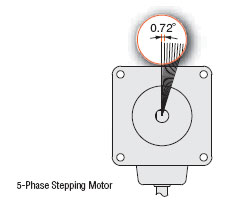
A stepper motor rotates with a stock-still step angle, just similar the 2d paw of a clock. This bending is called "bones step angle". Oriental Motor offers stepper motors with a bones step angle of 0.36°, 0.72°, 0.9° and 1.8°. 5-Stage stepper motors offer 0.36° and 0.72°, while ii-Phase stepper motors offering 0.9° and 1.8° footstep angles.
Utilizing Hybrid Stepper Motor Technology
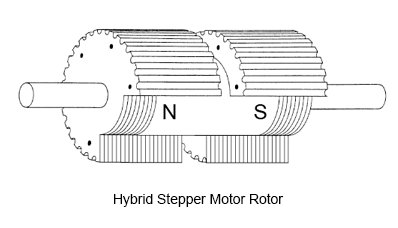
A hybrid stepper motor is a combination of the variable reluctance and permanent magnet blazon motors. The rotor of a hybrid stepper motor is axially magnetized like a permanent magnet stepper motor, and the stator is electromagnetically energized like a variable reluctance stepper motor. Both the stator and rotor are multi-toothed.
A hybrid stepper motor has an axially magnetized rotor, significant one end is magnetized as a northward pole, and the other cease a south pole. Toothed rotor cups are placed on each end of the magnet, and the cups are start past half of a tooth pitch.
Like shooting fish in a barrel Control with Pulse Signals
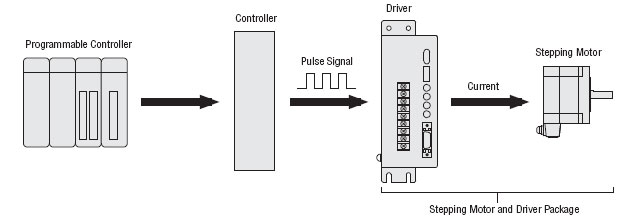
A system configuration for high accuracy positioning is shown beneath. The rotation angle and speed of the stepper motor tin be controlled with precise accuracy past using pulse signals from the controller.
What is a Pulse Signal?
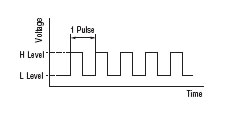
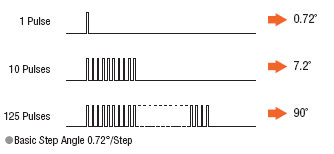
A pulse signal is an electrical indicate whose voltage level changes repeatedly between ON and OFF. Each ON/OFF cycle is counted equally one pulse. A control with i pulse causes the motor output shaft to plough by one step. The indicate levels corresponding to voltage ON and OFF conditions are referred to as "H" and "50" respectively.
The Amount of Rotation is Proportional to the Number of Pulses
The amount the stepper motor rotates is proportional to the number of pulse signals (pulse number) given to the driver. The relationship of the stepper motor's rotation (rotation angle of the motor output shaft) and pulse number is expressed as follows:
The Speed is Proportional to the Pulse Speed
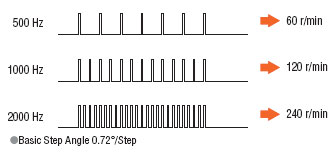
The speed of the stepper motor is proportional to the speed of pulse signals (pulse frequency) given to the driver. The relationship of the pulse speed [Hz] and motor speed [r/min] is expressed as follows:
Generating High Torque with a Compact Body
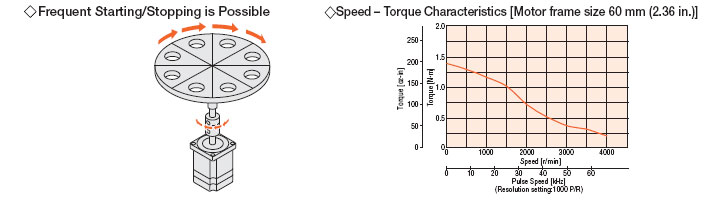
Stepper motors generate high torque with a compact body. These features give them excellent acceleration and response, which in turn makes these motors well-suited for torque-demanding applications where the motor must commencement and stop oft. To encounter the demand for greater torque at low speed, Oriental Motor too has geared motors combining compact design and high torque.
The Motor Holds Itself at a Stopped Positioning
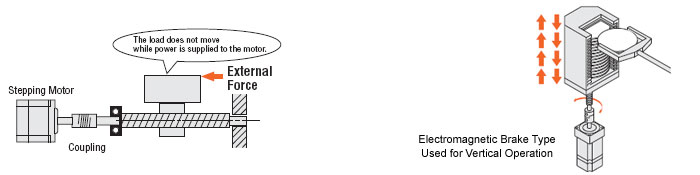
Stepper motors continue to generate property torque even at standstill. This means that the motor can exist held at a stopped position without using a mechanical restriction.
Once the power is cut off, the cocky-holding torque of the motor is lost and the motor can no longer exist held at the stopped position in vertical operations or when an external force is practical. In lift and similar applications, utilise an electromagnetic restriction blazon.
Closed Loop Stepper Motors and Drivers - AlphaStep
The AlphaStep consists of stepper motor and commuter products designed to describe out the maximum features of a stepper motor. These products normally operate synchronously with pulse commands, just when a sudden acceleration or load change occurs, a unique control way maintains positioning operation. AlphaStep models can also output positioning completion and alert signals, which increase the reliability of the equipment which they operate.
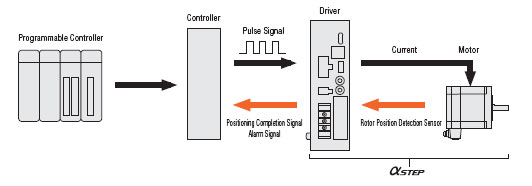
Types of Operation Systems
Each stepper motor and driver combines a stepper motor selected from various types, with a dedicated driver. Drivers that operate in the pulse input fashion and built-in controller fashion are available. You tin select a desired combination co-ordinate to the required operation arrangement.
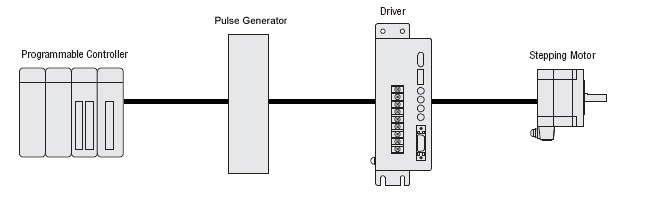
Pulse Input Driver
The motor can be controlled using a pulse generator provided by the user. Functioning data is input to the pulse generator beforehand. The user then selects the performance information on the host programmable controller, then inputs the operation command.
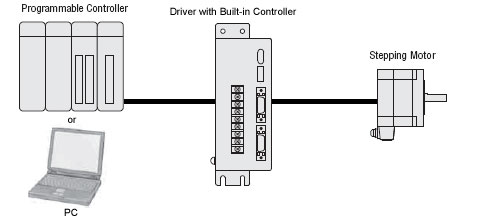
Born Controller Driver
The built-in pulse generation office allows the motor to be driven via a directly connected personal computer or programmable controller. Since no split pulse generator is required, drivers of this blazon save space and simplify wiring.
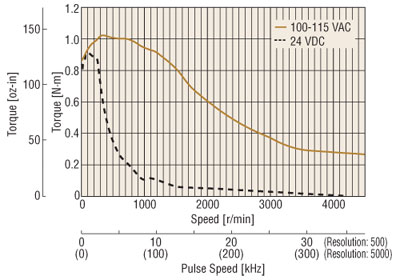
Difference Between Air conditioning Input and DC Input Characteristics
A stepper motor is driven by a DC voltage applied through a driver. In Oriental Motor's 24 VDC input motor and driver systems, 24 VDC is applied to the motor. In the 100-115 VAC motor and commuter systems, the input is rectified to DC and and so approximately 140 VDC is practical to the motor (certain products are exceptions to this.)
This departure in voltage applied to the motors appears as a difference in torque characteristics at high speeds. This is due to the fact that the higher the applied voltage is, the faster the current rising through the motor windings will be, facilitating the application of rated current at higher speeds. Thus, the AC input motor and driver system has superior torque characteristics over a wide speed range, from low to high speeds, offering a large speed ratio.
It is recommended that Ac input motor and driver systems, which are compatible over a wider range of operating conditions than DC input systems, be considered for your awarding.
Source: https://www.orientalmotor.com/stepper-motors/index.html
0 Response to "Stepper Motor Starts Then Stops Then Starts Again"
Post a Comment