Phila Out of the Darkness Luminaries O Art Museum

Philadelphia'south University of Music. Located at Broad and Locust Streets, it is the metropolis'southward oldest performance venue, presenting operas and concerts annually since 1857.


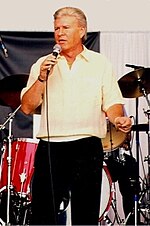
One of Philadelphia's first mainstream stars, Chubby Checker, in 2005
The city of Philadelphia, Pennsylvania, is dwelling to a vibrant and well-documented musical heritage, stretching back to colonial times. Innovations in classical music, opera, R&B, jazz and soul have earned the music of Philadelphia national and international renown. Philadelphia'south musical institutions take long played an important part in the music of Pennsylvania, also equally a nationwide impact, especially in the early on development of hip hop music.[i] Philadelphia's various population has too given information technology a reputation for styles ranging from dancehall to Irish gaelic traditional music, as well as a thriving classical and folk music scene.
The Philadelphia Orchestra's third conductor, Leopold Stokowski, championed American classical music of the 20th century, and on tour, in recordings, and notably in Walt Disney's 1940 animated film Fantasia, brought the traditional and modernistic classical repertoire to a wide American listening public for the offset time. The Curtis Establish of Music on Rittenhouse Square, founded in 1924 by Curtis Publishing Visitor heiress Mary Louise Curtis Bok, has trained many of the globe'southward all-time-known and respected American composers and performers, including Leonard Bernstein and Samuel Hairdresser during the 20th century and current stars Juan Diego Flórez, Alan Gilbert, Hilary Hahn, Jennifer Higdon, and Lang Lang.
The city has played an equally prominent role in developing popular music. In the early years of rock and roll, a number of South Philadelphia-built-in popular vocalists made Philadelphia and popular music near synonymous, including Chubby Checker, Frankie Avalon, and Bobby Rydell. This led to the ambulation of the pop stone and scroll dance show American Bandstand, from Philadelphia, hosted by 20-something Dick Clark from the Aqueduct 6 studios at 46th and Market Streets at the time, where teenagers would descend in droves after school to be televised dancing to the latest hits on the pop charts in front of a national audience.
Music venues and institutions [edit]

Philadelphia has a broad variety of performance venues for music. The city'southward most senior venue is the famed Academy of Music. Established in 1857, the Academy is the longest continuously operating opera house in the Usa that is nonetheless being used for its original purpose. At the very middle of Philadelphia'south musical life, the Academy is habitation to many internationally recognized operation ensembles, including the Philly Pops, the Pennsylvania Ballet and the Opera Company of Philadelphia. The Academy besides presents touring artists and musical theatre of the highest caliber.[2]
The near recent addition to the city's listing of venues is the Kimmel Center for the Performing Arts, home of the internationally renowned Philadelphia Orchestra, which opened in 2001. The Philadelphia Singers often sing in concerts with the orchestra. The center is likewise home to the Chamber Orchestra of Philadelphia, Philadanco and the Philadelphia Chamber Music Society (PCMS). The PCMS, established in 1986, puts on concerts past internationally renowned performers too every bit local ensembles like 1807 and Friends, who have been prominent local performers since 1981.
Also of major importance to the urban center is the Mann Eye for the Performing Arts, i of the largest outdoor amphitheatres in the United States.[3] Established in 1976 as the Robin Hood Dell West, the Mann Center is the summertime performance infinite for the Philadelphia Orchestra. Information technology is also host to major touring artists from all genres of music and is Philadelphia'south main venue for popular entertainers. In addition to the Isle of mann Middle, the Tower Theater, in Upper Darby, Pennsylvania simply outside Philadelphia serves as a destination for many meridian touring acts.
The Annenberg Heart for the Performing Arts is another notable venue in the city. Founded in 1971, the Center now includes the University of Pennsylvania's Irvine Auditorium, Zellerbach Theatre and Harold Prince Theatre.[iv] The middle offers a varied program of more than 170 performances each year, including concerts, theatre, and trip the light fantastic toe.
Philadelphia has a thriving jazz and cabaret scene, largely due to the efforts of the John W. Coltrane Cultural Society, which honors local jazz legend John Coltrane and helps to promote jazz in the city. There are a number of nightclubs in the city that host live music, most notably Warmdaddy's which has been a hot spot for jazz and dejection entertainers for more than than four decades. The urban center is also dwelling house to the Clef Order of Jazz and Performing Arts, which has been chosen the "first-ever social club designed and constructed specifically every bit a jazz institution". Another notable venue is World Cafe Live (WCL), which opened October 2004. A three-tiered music hall, eating place, and bar, WCL has been host to such artists as George Clinton and the Parliament-Funkadelic, Rhett Miller, Natalie Cole, KT Tunstall, Allen Toussaint, Pink Martini, Buckethead, and Liz Phair.
Philadelphia's diverse ethnic groups take established several organizations that promote their musical styles, including the Asian Arts Initiative and the Latin American Musicians Association (AMLA). The AMLA was established by Jesse Bermudez in 1982 in North Philadelphia, to promote Latino music and musicians. The Association runs a Latin Schoolhouse of Arts, which features teachers similar Elio Villafranca and Pablo Batista.[5] The Italian American Broadcasting Network is based out of Philadelphia and promotes radio stations that broadcast Italian music in southeastern Pennsylvania; the Philadelphia stations that play Italian music include WPHT, WEDO and WEMG.[six] The Painted Bride Art Center is a local arrangement which promotes alternative and avant garde music, while Crossroads Music is the urban center's but arrangement entirely dedicated to presenting musicians with roots in specific cultural traditions from all parts of the world
Other local institutions include the Philadelphia Gay Men's Chorus, founded in 1981,[seven] and the Mendelssohn Club, a choral group that dates back to the 19th century. The Mendelssohn Club was founded by William Gilchrist, one of the major figures of 19th century music in the city.[eight] As well of annotation is the Philadelphia Youth Orchestra, one of the most highly regarded children'southward groups in the Us, having performed worldwide since forming in 1939.[9]
A local and highly respected musical novelty is the Wanamaker Organ, located in the Eye City Macy's department store at 1300 Market. Its organ was built in 1904, designed past organ architect George Ashdown Audsley. The organ was so large it required thirteen freight cars to bring it from St. Louis. Once in Philadelphia, the organ was fabricated even larger, with boosted pipes added—3,000 were added past 1917, and between 1924 and 1930, 10,000 more were added. The modern organ has 28,500, ranging from a 32-foot (9.8 m) long and 3-inch (76 mm) thick piping made of Oregon sugar pine and a tiny, quarter-inch long pipe. Performances on the Wanamaker Organ are given twice a solar day, Monday through Saturday.[x]
Music festivals and annual events [edit]
Major music festivals in Philadelphia include the Westward Oak Lane Jazz Festival (held annually in June), the Bach Festival of Philadelphia (since 1976), and the long-continuing and historical Philadelphia Folk Festival.[11] There are as well a number of unlike summer concert serial and indigenous festivals held at Penn's Landing, including the Smooth Jazz Summer Nights Series in August. The Jazz on the Ave Music Festival (since 2006) typically takes identify in mid Baronial on Broad Street and Cecil B. Moore Avenue featuring Jazz, Soul, Gospel and R&B, as well as some gimmicky urban music. The Philadelphia Céilí Grouping is a prominent local organization that promotes Irish music, and runs a festival, which the Group claims is among the oldest continuous Irish traditional festivals in the United States.[12] Not as well far from the urban center is the almanac Concerts Under the Stars summer festival in Upper Merrion township.
Peradventure the most famous annual musical upshot in Philadelphia is the Mummers Parade, a New year's Day celebration that features outrageous costumes, old-time cord bands and other entertainment. The tradition dates to the mid-17th century, when Finnish and Swedish settlers in Philadelphia celebrated holidays by shooting muskets. Their parade grew more diverse over the years, and the Mummers tradition became official in 1901, and has occurred every year but two since. The Mummers' cord band is a large group of several dozen musicians who play banjos, violins, bass viols, glockenspiels, bells, accordions, saxophones and drums in an "sometime-fashioned, tinny audio approximating the popular music of 1900 and earlier".[13]
Music history [edit]
The primeval music in the Philadelphia region was that of the indigenous peoples of the expanse, though trivial is known nigh their music. The urban center was founded in 1682 past William Penn of England on land granted to him by Charles 2 as a place of refuge for victims of religious persecution. As a result, much of the city'due south early music history is tied to sacred music from a multifariousness of different religious traditions. The city'due south German immigrants were particularly influential in establishing a vibrant musical culture amongst Protestant churches and in the field of music publishing during the first half of the 18th century.
While non-religious music was actively performed in homes and in individual social clubs during the early colonial menstruation, public performances of non-religious music did not occur until the 1750s. At that time Philadelphia rose to prominence as the major cultural capital in the Thirteen Colonies of Northward America, and so in the fledgling United States. The metropolis established a reputation for classical music of Haydn and Mozart . It had the all-time opera and theater scene in the Usa during the latter half of the 18th century.
In the 19th century and early 20th century, Philadelphia'due south population, like those of other major American metropolitan areas, grew steadily more diverse, with immigrants from Republic of ireland, Russia, and Italy (in that lodge) landing on the banks of the Delaware Bay and constituting the largest groups. Philadelphia became a regional center for Italian music and too produced a number of well-regarded Irish musicians and groups. The city's sizable Jamaican population brought their own styles of music, such as dancehall, which became a major part of the Philadelphia nightclub scene in the early first decade of the 21st century.[14]
Colonial era and tardily 18th century [edit]
Religious music [edit]
Philadelphia became an important center for music in North America during the colonial era and late 18th century. During the early colonial menstruum, music-making took place mainly in the church and the domicile. Although the original settlers of Philadelphia were English Quakers who had little interest in music, William Penn's hospitality to other religious groups ensured the eventual growth of musical activities. German immigrants who began arriving in the city around 1700 brought musical instruments with them, congenital organs, and composed hymns. Some of the earliest press of sheet music came from these German immigrants and more than than 20 editions of German-linguistic communication hymnals were printed in the urban center before 1750. Past the mid-18th century the urban center was the leading center for music press in the New Earth. One of the earliest English-language hymnals from the United states that still survives is an extant re-create of Isaac Watts' Hymns and Spiritual Songs, printed in 1741 past Benjamin Franklin.[15] Of the colonial hymnbooks in English language, the largest and almost significant was Urania, or A Option Collection of Psalm-Tunes, Anthems, and Hymns, compiled by James Lyon (Philadelphia, 1761).
Colonial Pennsylvania was home to a number of religious minority sects, several of which take played an of import office in the musical evolution of the area. A number of German Pietists settled in the Philadelphia area in 1694, led past Johannes Kelpius. These Pietists lived along the banks of the Wissahickon Creek, and became known as the Hermits (or Mystics) of the Wissahickon. Kelpius was a hymn writer and musician. Kelpius has been said to exist the composer of certain hymn tunes, although music historian Gilbert Chase doubts that he wrote the music, much of which, Chase claims, "is taken from readily identifiable German sources". These hymns were translated into English by Christopher Witt, a painter and musician said to have built the beginning individual (i.e. non-church) organ in the colonies of North America.[sixteen]
The urban center of Philadelphia has as well been a major middle for Roman Catholic church music. The kickoff Cosmic hymnbook published in the United States came from Philadelphia in 1787, entitled Litanies and Vesper Hymns and Anthems as They Are Sung in the Catholic Church; this collection included music scored for treble and bass, with later editions calculation a 3rd vocal section, and used highly ornamented plainchant themes in the Mass and hymns. The publisher Mathew Carey was particularly influential, publishing a catechism in 1794 that included hymns in later on editions.[17]
Non-religious music [edit]
Performances of early non-religious music were originally relegated to the abode or private social clubs in the city. The primeval known private concert was given in 1734, the kickoff known public concert in 1757. Subscription concerts featuring a bedroom orchestra were initiated in that twelvemonth, including music by contemporary English, Italian, German and Bohemian composers, largely through the efforts of Governor John Penn and Francis Hopkinson, a signer of the Annunciation of Independence and amateur composer and performer.
After the American Revolutionary War, a substantial number of professional person musicians from Europe arrived in Philadelphia. Rayner Taylor, Alexander Reinagle and Benjamin Carr were the leading figures in the metropolis's musical life around the turn of the 18th century. These men had emigrated from England and were active as performers, composers, conductors, teachers and concert managers. Susannah Haswell Rowson was an important female composer active in the metropolis. She wrote the librettos for two of Reinagle's compositions, and was a successful poet, guitarist, vocaliser, playwright and actress. Benjamin Franklin was also a musician, a guitar teacher and inventor of musical instruments similar the glass armonica.[xviii] In 1784 Andrew Adgate organized the Institution for the Encouragement of Church Music, renamed the Uranian Academy (1787–1800). The school was the center of the city'south choral music scene during the latter part of the 18th century.
The earliest known performance of a musical drama in Philadelphia was Colley Cibber'south Flora, or Hob in the Well, a ballad opera performed past a touring opera visitor from England in 1754. In 1757 Francis Hopkinson mounted an elaborate production of Thomas Arne's masque Alfred. Both the Social club Hall Theatre, built past David Douglass in 1759, and the Southwark Theatre, which opened in 1766 with Arne'south Thomas and Sally, staged productions of plays and operas given by the American Company. Although the Quakers and other religious groups expressed their moral opposition to theatrical performances, comic operas past leading British composers were oft performed, often soon after their premières in London.
During the revolutionary menstruation expensive theatrical entertainments were prohibited, except during the time of the British occupation, and the ban remained in effect until 1789. After the ban was lifted, Philadelphia became one of the nation's main theatrical centers. The New American Visitor, founded in 1792 past Reinagle and Thomas Wignell, recruited a big number of singers and composers from England. Although the master repertory was from London, several composers who lived in Philadelphia wrote original operas; amid the most successful were Carr's The Archers (1796), Reinagle's The Volunteers (1795), and Taylor's The Aethiop (1814). Of prime importance to the success of opera was the construction in 1793 of the New Theatre (later on known as the Chestnut or Chesnut Street Theatre), by Reinagle and Wignell. Several Mozart operas made their United States debut in the New Theatre including Don Giovanni and Union of Figaro both in 1793. Taylor and Carr also worked at the New Theatre which was the most first-class theatre in the United States in its mean solar day. The building seated nigh 2000 people, and its design was based on the Theatre Royal, Bath in England.
Early to mid 19th century [edit]
Philadelphia's Holy Trinity Church building published the first German-American Cosmic canon in 1810, while the music director of St. Augustine'due south Cosmic Church building, Benjamin Carr, too published hymnbooks in the early 19th century. Carr's 1805 work introduced "O Sanctissima" and "Adeste Fideles" to American Catholics. The American Sodality movement began in Philadelphia in 1841, founded by Felix Barbelin; Barbelin personally prepared the first American Sodality Manual, which was followed by others throughout the later on 19th century. The Catholic Church of Philadelphia established important institutions of musical instruction in the early 19th century, with the foundation a singing school and boys choir. Throughout the 1810s premieres of Ludwig van Beethoven'southward works like his Eroica Symphony which premiered in 1811. The Sisters of Notre Dame de Namur and the Sisters of the Holy Child published several collections of hymns, some of which were later included in St. Basil's Hymnal.[17]
Philadelphia's African American musical heritage dates back to colonial times, and gained some national and international renown beginning with Frank Johnson, who settled in Philadelphia around 1809. Johnson composed marches and quadrilles that became very pop; he even performed for Queen Victoria in 1837. By the end of the century, African Americans in Philadelphia had their own musical institutions, including a symphony orchestra and choral societies.[19]
With the inauguration of the Musical Fund Society in 1820, musical activity in Philadelphia greatly increased. By the mid-19th century the urban center was a national center for musical evolution, with local religious music irresolute considerably, and new styles becoming regionally pop, particularly English language opera. An important concert was held in Philadelphia in the mid-19th century, one of the first major concerts in the land led by a chorus, in this case from the College of Philadelphia.[20] Philadelphia saw the première in 1845 of the kickoff American one thousand opera, Leonora by composer and music journalist of the National Gazette and the Public Ledger, William Henry Fry. The opera was written in the Italian style and admired and so much that it was performed 16 times that flavour.

Philadelphia's University of Music, the "Grand Old Lady of Broad Street," was founded in 1855. When it opened it was by far the finest opera business firm in the United states. Built by the Philadelphia firm of Napoleon Le Brun and modeled after La Scala, the house has 3 balconies, an impressive interior and nearly 3000 seats. The groundbreaking anniversary was held on June eighteen, 1855, with President Franklin Pierce in attendance and the venue opened with a m ball on January 26, 1857. The first opera performed there was the western hemisphere premiere of Giuseppe Verdi'south Il Trovatore, on Feb 25 of the same twelvemonth. The Academy of Music is the oldest existing opera firm in the United States and was alleged a National Historic Landmark in 1963; it remains the primary opera firm for the city and is the home of the Pennsylvania Ballet. Information technology was the principal concert hall in Philadelphia until the opening of the Kimmel Center for the Performing Arts in 2001. Many first American performances were given there, including Charles Gounod's Faust (in German, 1863), Richard Wagner's Der fliegende Holländer (in Italian, 1876) and Arrigo Boito'south Mefistofele (1880).
Belatedly 19th century [edit]
In the second half of the 19th century, ii boosted opera houses were opened: the Chestnut Street Opera House (1885) and the Grand Opera House (1888). With three houses available, the city was able to concenter touring companies that featured the finest European stars. A number of American premières were directed by Gustav Hinrichs at the Grand: Cavalleria rusticana (1891), L'amico Fritz (1892), Les pêcheurs de perles (1893), Manon Lescaut (1894) and Hinrich's own opera, Onti-Ora (1890).
The city's first resident orchestra of importance, the Germania Orchestra was founded in 1856. Under the management of Carl Lenschow, the ensemble gave annual serial of concerts up through 1895. The usher and impresario Theodore Thomas likewise presented i or two concert series each flavor between 1864 and 1891. During the centennial commemoration of American independence in 1876 the Thomas Orchestra gave concerts throughout the summer simply, as the programs were too weighty and the hall too far from the center of the city to attract a large audience, Thomas suffered a great fiscal loss.
The metropolis'due south large High german population supported several singing societies. The Männerchor (1835–1962), the Junger Männerchor (from 1850) and Arion (1854–1969) have been disbanded, but Harmonie (1855) and eight other German language choral groups remain active. Other important early choruses were the Abt Male Chorus, led successively by Michael Cantankerous and Hugh Archibald Clarke, and the Eurydice Chorus (1886–1918). Two choruses withal flourishing are the Orpheus Club of Philadelphia, founded in 1872 it is America'southward oldest men'due south chorus of its kind,[21] and the Mendelssohn Club, founded in 1874 by Philadelphia composer and musician William Wallace Gilchrist.[8] [17]
The Philadelphia Roman Cosmic musical tradition produced the celebrated and controversial composer Albert Rosewig, who was active in Philadelphia from 1880 through 1919. Rosewig "used romanticized harmony for Gregorian chants, and even harmonized the priest'due south altar chants" in an attempt to contain then-current styles of classical music. His innovations were somewhen forbidden by Pius X. Later on, the Philadelphia-area conductor and composer led the United states of america in the development of a more traditional style in the 20th century.[17]
In the 19th century Philadelphia was an of import centre for the limerick, publication and operation of pop music, and past the second half of the century more than 100 composers were writing songs and dances for the theatre and salon. Minstrel shows were enthusiastically received, and in 1855 the offset blackness minstrel theatre was opened. The local minstrel performer James A. Banal composed songs that attained phenomenal success, especially "Acquit Me Back to Old Virginny" (1878) and "Oh, dem Golden Slippers" (1879). The latter became the 'theme song' of the Mummers, who established clubs and formally inaugurated the annual tradition in 1901 of dressing in improvident costumes and parading on New Year's Day while performing on banjos, guitars, saxophones and glockenspiels.
20th century [edit]
Philadelphia Orchestra [edit]
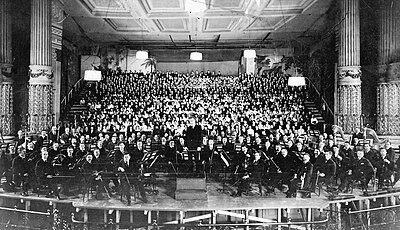
The Philadelphia Orchestra performs the United States premiere of Mahler'southward Symphony No. 8 in Eb conducted by Leopold Stokowski in 1916.
Philadelphia became domicile to the Philadelphia Orchestra in 1900, for much of its history considered preeminent amid American orchestras and ane of the "Big V" American ensembles. The Orchestra was initially led past Fritz Scheel; in 1907, Karl Pohlig took up its baton. But it was the usher Leopold Stokowski who made the Orchestra one of the nigh prominent in the country. Stokowski jointly held the conductor'due south post with Eugene Ormandy beginning in 1936, with Ormandy taking over completely in 1938.
Under the direction of Stokowski and Ormandy, the Philadelphia Orchestra produced several well-known recordings in the 20th century, including the 1940 score for the Disney film Fantasia, and the Orchestra under the flamboyant "Stokie" with his souvenir for cocky-promotion pursued an aggressive schedule of national and international tours, condign the template for the mod classical orchestra in the 20th century. After Stokowski's divergence, Ormandy led the Orchestra into the 1970s, preserving its lustrous sound and relying on the popular classical repertoire that had made the "Philly sound" famous, when it became the first American orchestra to visit Cathay and perform in the Great Hall of the People in Beijing; the Chinese tour was well received and has since been repeated three times.[22]
The 20th century saw the Orchestra go the showtime of its kind to make electrical recordings, to perform on its ain commercially sponsored radio circulate, to perform on the soundtrack of a characteristic flick (The Large Circulate), to appear on a national television broadcast, to tape the complete Beethoven symphonies on meaty disc, to give a live cybercast of a concert on the Cyberspace, and to bout Vietnam.[22]
Opera [edit]
The Philadelphia Opera House was congenital over the grade of just a few months in 1908 by impresario Oscar Hammerstein I. The firm was initially the home of Hammerstein'southward opera visitor, the Philadelphia Opera Visitor, but was sold to the Metropolitan Opera of New York City in 1910, when it was renamed the Metropolitan Opera House. The Metropolitan Opera'south association with the urban center of Philadelphia began during its start season, presenting its entire repertoire in the urban center during January and August 1884. The company'south start Philadelphia performance was of Faust (with Christina Nilsson) on January 14, 1884 at the Chestnut Street Opera Firm. The Met continued to perform annually in Philadelphia for most eighty years, taking the entire company to the city on selected Tuesday nights throughout the opera season. With the exception of ten years spent performing in Hammerstein'southward opera business firm, the Met mostly performed at the Academy of Music. In 1961 the Met's regular visits ceased after having given close to 900 performances in Philadelphia.
Since the end of World War I many local opera companies take operated in Philadelphia. The Pennsylvania One thousand Opera Company and the Philadelphia Civic Opera Company were two companies agile up until the Wall Street Crash of 1929 forced them to close their doors. The Philadelphia Grand Opera Company was the name of iv dissimilar American opera companies active at the University of Music during the 20th century. The last and most well known of the iv was founded in November 1954 with the merger of the Philadelphia Civic Grand Opera Company and the Philadelphia La Scala Opera Company. That company in plough merged with the Philadelphia Lyric Opera Company in 1975 to form the city'southward only electric current producer of grand opera, the Opera Company of Philadelphia. Of the three earlier companies, only i lasted across i season; a visitor founded in 1926 which later became associated with the Curtis Establish of Music in 1929. That visitor closed its doors in 1932 due to fiscal reasons during the Bang-up Depression. The metropolis's music schools also regularly produce operas, and the American Music Theater Festival, founded in 1984 under Marjorie Samoff, occasionally presents gimmicky operas.
Curtis Institute of Music [edit]
Too in the realm of serious music was the founding in 1924 of the classical conservatory, the Curtis Institute of Music, by Mary Louise Curtis Bok, girl of Curtis Publishing Company founder Cyrus H.G. Curtis. Curtis has trained some of the world's best-known composers and musicians, including Samuel Barber, Gian Carlo Menotti, Leonard Bernstein, and pianists Abbey Simon, Walter Hautzig, Richard Goode, Susan Starr and Peter Serkin as well as current international performers including David Hayes, Juan Diego Flórez, Alan Gilbert, Hilary Hahn, Lang Lang and Vinson Cole. Currently well-known composers who are Curtis graduates include Daron Hagen and present day kinesthesia member Jennifer Higdon. Other famous faculty members at Curtis over the years include pianists Jozef Hofmann, Rudolf Serkin, Gary Graffman and Mieczyslaw Horszowski, singers Margaret Harshaw, Eufemia Giannini Gregory, Charles Kullman and Richard Lewis, violinist Efrem Zimbalist and composers George Frederick Boyle and Randall Thompson. .[23]
Chamber music [edit]
Philadelphia has also had an agile sleeping accommodation music scene. One of the well-nigh prominent professional person groups in the early 20th century was the Curtis String Quartet (1932–81). The members were graduates of the Curtis Establish, and the quartet travelled widely and made many recordings. The Philadelphia String Quartet, made up of members of the Philadelphia Orchestra, was formed in 1959 and in 1967 became the quartet-in-residence at University of Washington. Members of the Philadelphia Orchestra oft give chamber music concerts. The Concerto Soloists, founded in 1964 by Marc Mostovoy, were the city's principal professional sleeping room orchestra, succeeded and reorganized as the Chamber Orchestra of Philadelphia. The Philadelphia Chamber Music Society, established in 1986, brings prominent chamber groups and soloists to the city.
Choral music [edit]
Several notable local choruses existed in the city during the 20th century. The Philadelphia Choral Society (1897–1946), conducted by Henry Gordon Thunder, was the urban center's major chorus for many years. Other one-time choruses include The Treble Clef Club (1884–1934), the Palestrina Choir (1915–48), and the Accademia dei Dilettanti di Musica (1928–60), the Pennsylvania Pro Musica (1972-20??).[24] Still flourishing are Mendelssohn Club of Philadelphia (1874), Singing City (1947), the Philadelphia Choral Arts Society (1982) and VoxAmaDeus (1989). The Philadelphia Singers, founded in 1971, was the metropolis's main professional choir under the management of David Hayes, only disbanded in 2015. The Philadelphia Boys Choir & Chorale is the city's premier boys choir since 1968.
Popular music [edit]
Philadelphia also produced innovative performers in fields every bit varied as popular, punk rock, soul and jazz. Equally Chuck Berry and Buddy Holly were creating rock and roll during the eye 1950s, Philadelphia—then experiencing a citywide cultural and political renaissance led by Mayors Joseph Due south. Clark and Richardson Dilworth and master city planner Edmund Bacon—began in 1956 to host the national tv evidence that would testify to transform pop music in America and effectually the world by bringing stone and roll brightest stars to West Philadelphia to back-trail Philadelphia school kids as they danced after school at 46th and Market Streets--"American Bandstand" with host Dick Clark. The city spawned some of early rock's best-known vocalists during the fifties and early sixties, including Chubby Checker, Frankie Avalon, Jimmy Darren, Mario Lanza, Fabian Forte, and Bobby Rydell. This period was explored to some extent in a network television drama prepare in Southward Philadelphia, American Dreams.
Philadelphia's jazz heritage is noteworthy, especially as the city that John Coltrane moved to subsequently graduation, 1 of the most innovative performers of the 20th century. The Philly soul audio of the 1970s was besides an specially of import office of the national musical consciousness of its era.
Punk stone [edit]
The city too has a distinguished history with local indie rock and punk. Punk band Pure Hell formed in the 1970s. The 1980s saw a local New Wave scene with bands like Johnny's Dance Band (JDB), alongside hardcore punk bands like Sadistic Exploits. The 90s indie rock scene found greater national popularity through the bands Dead Milkmen and Zen Guerilla,[25] The Dead Milkmen would go on to lead the charge in a satire punk era on MTV during the belatedly lxxx's, while the city as well produced an electronic music scene, known for acts like Dieselboy and Josh Wink.
Gospel [edit]
Philadelphia'south gospel heritage stretches back to Charles Albert Tindley, a local reverend,[26] who composed many important hymns. Tindley's "I Do, Don't You" inspired the composer Thomas A. Dorsey, who credited Tindley with the innovation of gospel music. Tindley composed most of his works between 1901 and 1906, and was known for his booming preaching style.[27]
Philadelphia has produced a number of popular gospel acts, nearly famously the singer Clara Ward. Ward rose to fame after a operation at the National Baptist Convention in Philadelphia in 1943. Ward formed a group with several other local singers, and toured widely throughout the decade; the Clara Ward Singers were known for bringing a sense of style and glamour to the emerging gospel music manufacture.
The Dixie Hummingbirds are also one of Philadelphia'southward most famous International Quartet Groups, who are withal performing today. Since early in the 1920s this grouping has remained :"The Gentlemen of Song", with their signature White Tails Suits and their inimitable harmony, keeps the Gospel Quartet alive and well in the 21st Century.
Irish gaelic music [edit]
Philadelphia became home to a large customs of Irish immigrants in the 1840s, and so continually through the later 19th and 20th centuries. These immigrants brought with them many styles of traditional Irish music, such as jigs and reels. Beginning in the late 1940s, Philadelphia's Irish music scene grew rapidly, spurred in part by the broadcasting of live music past Austin Kelly and the All-Ireland Irish Orchestra by the WTEL radio station.
Modern Philadelphia has contributed a number of of import performers of Irish music, well-nigh famously Mick Moloney, John Vesey, Kevin McGillian and Séamus Egan, both of whom were part of a nationwide resurgence of interest in traditional Irish-American music.[28] In Philadelphia, this revival of traditional music built on the work of earlier pioneers like Ed Reavy, a composer who began working in the 1930s.
Philadelphia'southward about famous contribution to Irish traditional music is Mick Moloney. Moloney was from County Limerick, and was a musician both in Composition and in Dublin, playing the banjo and singing; he was likewise a member of the popular folk group The Johnstons. Having emigrated to Philadelphia in 1973, Moloney has lectured widely on Irish culture and music and founded the organization Green Fields of America, which promotes Irish-American music. Egan is a multi-instrumentalist originally from Philadelphia, though he moved dorsum to County Mayo as a fellow, and has there become a prominent musician. He is co-founder of the Irish gaelic music band Solas, and he co-wrote Sarah McLachlan's hit vocal "I Will Retrieve You", featured in the soundtrack for the pic The Brothers McMullen, for which Egan also provided the score.[28]
Roman Catholic church building music [edit]
Albert Rosewig had get a prominent local reverend and musical arranger in the belatedly 19th century, known for a modernistic fashion that adapted elements of Western classical music. In 1903, nevertheless, Pope Pius X issued an edict (Motu Proprio), which was intended to reform and restore church building music to a more traditional style. To that finish, local composer, conductor and publisher Nicola Montani led the reform, which restricted musical mode and instrumentation, and encouraged the employ of polyphony, Latin and restored Gregorian chant. He was non the simply noted local liturgical composer, however, as 1000. Immaculée, music director of Immaculata College, was likewise a well-known composer; she was noted as a composer of choral works, and also promoted liturgical music, and female person composers, in the Philadelphia area.[17]
Montani was from New York, but became prominent in Philadelphia equally an editor for liturgical music at local publishers, and music director at several Philadelphia Catholic high schools. By the 1920s, he had grown in stature, forming the Society of St. Gregory and the Palestrina Choir, which helped to bring attention to Renaissance polyphony and publishing the Cosmic Choirmaster, a magazine. Montani also created a list of music that did and did non see the standards put forth by Motu Proprio, in the process banning or altering well-known works by composers ranging from Franz Schubert and Gioacchino Rossini to Joseph Haydn and Wolfgang Amadeus Mozart.[17]
Montani's St. Gregory Hymnal was used throughout Philadelphia-area Catholic churches until after the Second Vatican Council. Some modernistic churches in the city utilize instruments ranging from electric organs and guitars to keyboards, saxophones and marimbas. The International Eucharistic Congress was held in Philadelphia in 1976, commissioning a new hymn entitled, "Gift of Finest Wheat", whose use has become widespread. In 1979, Pope John Paul Ii visited Philadelphia and historic a public outdoor mass for 1.2 million on the Benjamin Franklin Parkway on Oct three, 1979. For that visit, a mass choir was formed and led by Dr. Peter LaManna which continued existence as the Archdiocesan Choir of Philadelphia.[17] [29]
Jazz [edit]

Philadelphia developed an early jazz scene, beginning with Ethel Waters, a vocaliser from nearby Chester, Pennsylvania, who was the first star for Black Swan Records. The Standard Theatre and Dunbar Theatre (later renamed the Lincoln Theater) were important venues for jazz in the early 20th century, when most major performers stopped in Philadelphia, Baltimore, Washington, and New York. Though jazz was an African American creation coming out of Gospel and Blues, Philadelphia'southward multi-ethnic population was attracted to the manner, and the city's Italian and Jewish neighborhoods produced several well-known jazz musicians. Two of the most important were the Italian jazz instrumentalists Eddie Lang and Joe Venuti, the latter of whom became known as the "Mad Fiddler from Philly". Others included Stan Getz, Jimmy Amadie, Robert Chudnick and Jan Savitt, who, with his ring the Elevation Hatters, toured with George Tunnell, one of the first African American singers in the city to consistently sing with a major white ring. The metropolis'southward early 20th century mainstream dance scene was led past the bandleader Howard Lanin, whose band performed popular showtunes, waltzes and calorie-free jazz.[30] [31]
Philadelphia's African American population grew profoundly as a upshot of clearing from the south during World War 2, when future luminaries similar the Heath Brothers, Dizzy Gillespie and John Coltrane moved to Philadelphia from the Carolinas. Philadelphia's mid-20th century jazz heritage includes an important role in the evolution of bebop, a style well-nigh closely associated with New York. In the 1940s, Philadelphia jazz was based out of clubs along Columbia Avenue in Northward Philadelphia and clubs like the Clef Club, the Showboat, and Pep's in South Philadelphia.[32] The city produced a number of bop-era saxophonists, the most famous of whom was John Coltrane, one of the most renowned jazz musicians of the 20th century, known for an "active, vigorous, emotionally charged style".[30] The city also produced Charlie Biddle, Clifford Brown, Ray Bryant, Tommy Bryant, Kenny Dennis, Jimmy Oliver, Catalyst, Philly Joe Jones, Al Grey, Reggie Workman, Red Rodney, Jimmy Smith, Hank Mobley, Billy Root, Specs Wright, Jerry Thomas, Wilbur Ware, Hasaan Ibn Ali, Clarence Sharpe, John Dennis, Walt Dickerson, Johnny Coles, Lee Morgan, Cal Massey, Benny Golson, Odean Pope, Nib Barron, Kenny Barron, Arthur Harper, Jymie Merritt, Henry Grimes, Leon Grimes, Jimmy Garrison, Colmar Duncan, Sherman Ferguson, McCoy Tyner, Kenny Rodgers, D.B. Shrier, Mickey Roker, Donald Bailey, Victor Bailey, Thornel Schwartz, Bootsie Barnes, Bobby Timmons, Spanky DeBrest, Sam Dockery, Wayne Dockery, Richard Grossman, Sonny Fortune, Tyrone Brown, Charles Fambrough, Gerald Veasley, Earl Grubbs, Carl Grubbs, Sam Reed, Tom Darnell, Jimmy Vass, Archie Shepp, Sunny Murray, Rashied Ali, and Buddy Delco.[32] And habitation grown, 20th and Columbia Ave'southward own, trumpeter Cullen Knight, Jr.
In 1970, Philadelphia became the domicile of Sun Ra's band, which helped lay the background for the 1980s scene, which locally produced Grover Washington, Jr. and Stanley Clarke. The 1990s local jazz scene continued to thrive with artists similar Tim Warfield, Terell Stafford, Jamaaladeen Tacuma, Marker Kramer, Uri Caine, Christian McBride, Joey DeFrancesco, Orrin Evans, Ben Schachter, Larry McKenna, Mike Boone, and Byron Landham.[30]
The metropolis has a thriving jazz radio station in WRTI, sponsored by Temple University. Its hosts include such notables every bit Bob Perkins, Jeff Duperon, and Harrison Ridley Jr. The Peco Free energy Jazz Festival is held each Feb.
1950s pop [edit]
Philadelphia'south outset major contribution to mainstream American popular music was the goggle box show American Bandstand, hosted by Dick Clark. The show featured music and dancing teenagers and became an enduring feature of American music and television, groundbreaking in its broadcasting of stone and curl in the mid-1950s.,[33] Unterberger besides points to many later imitators as prove of American Bandstand 'due south legacy: Soul Train and the Sabbatum Night Live parody Sprockets. PCVB[34] regards American Bandstand as an "institution in American pop culture". Clark, equally the show's host, became a leading American music producer and the bear witness brought attention to Philadelphia'south music scene, facilitating the ascent of local labels like Swan Records, Cameo-Parkway and Chancellor Records. This system produced pop stars including Fabian, Bobby Rydell and Frankie Avalon. A payola scandal threatened the evidence and Clark at one point but subsequent congressional hearings cleared the music mogul of wrongdoing. Nevertheless, the testify moved to Los Angeles in 1963 and Philadelphia's pop output began to wane.[35]
Philadelphia'southward 1950s-era musical output included the stone pioneer Bill Haley from Chester, Pennsylvania and the rockabilly musician Charlie Gracie. Philadelphia also had a vibrant R&B and soul scene, including well-nigh influentially the label Cameo-Parkway, which was responsible for some 1950s R&B trip the light fantastic toe hits outset with Chubby Checker's "The Twist". Cameo-Parkway followed with a serial of other dance-themed novelty songs like "The Wah-Watusi" by The Orlons, "Mashed Potato Time" by Dee Dee Sharp and "The Bristol Stomp" by The Dovells.[36]
Philadelphia's famous 1950s performers also included Danny & the Juniors, a doo wop group. They were amongst the first of Philadelphia's doo wop musicians to proceeds national success. Doo wop was a manner of a cappella vocal music associated with many cities of the urban East Coast, especially Philadelphia, New York, New Jersey and Baltimore. Anthony and the Sophomores, some other Philadelphia doo wop group, emerged in the 1960s.
Philly soul [edit]
In the 1960s, Philadelphia soul began to develop its own audio, cartoon from the daughter group sound with "strong popular melodies and brassy, upbeat product (without as much utilize of) interactive harmonies",[37] while other performers, like the funky Howard Tate and Solomon Burke adopted a more Southern soul-fashion sound. Major girl group-oriented acts included Brenda & the Tabulations, with their string-dominated doo wop hit "Dry Your Eyes", Barbara Mason's sultry vocals on "Yes, I'm Ready" and Claudine Clark's "raucous" sound. The near influential of these performers, however, was Patti LaBelle, who became a major pop singer in the 1970s.[38]
R&B and soul-oriented indie labels in the 1960s included Phil-LA and Arctic Records, where the songwriting and producing squad of Kenny Risk and Leon Huff began their careers. Gamble and Huff were architects of the Philadelphia audio in soul music, starting time with their 1967 hit for The Soul Survivors' "Motorway to Your Heart". Their signature audio was sentimental and romantic, and began to develop with The Intruders, a long-running popular act. Jerry Butler became an increasingly of import performer later in the decade, as Gamble and Huff experimented with a lush, orchestral sound produced by large ensembles of strings, bells and horns. The consequence was a "funky" style, "more removed from before soul'south R&B and dejection roots", and "reminiscent of Motown in its attention to detail and hooks, but was much more lightweight". Though Gamble and Huff were the near renowned producers of the Philly soul scene, the expanse also produced Thom Bell, who worked with The Delfonics, The Stylistics and The Spinners on a more than doo wop-influenced fashion.[37]
In the early 1970s, Philly soul broke through with its almost popular recordings of the era. Gamble and Huff'south Philadelphia International label started the tendency afterwards signing a distribution agreement with CBS. The O'Jays became the beginning major act under this system, and became known for a grittier lyrical feel, established on the hit "Dorsum Stabbers", which had a socially conscious focus on inner-city life. The O'Jays were followed by the more romantic Harold Melvin & the Blue Notes, which produced the future solo vocalist Teddy Pendergrass.,[39] Philadelphia International released Baton Paul, Three Degrees, MFSB, Bunny Siglar, Dexter Wansel, Anthony White, and The Ebonys[40] also.
By the early 1980s, Philadelphia soul had declined greatly in popularity. Audiences embraced disco, where Philadelphia's merely major contribution was the local veteran Patti LaBelle. The city remained important musically, giving rise to widely pop local bluish-eyed soul duo Hall & Oates.
Contempo music scene [edit]

In the late 20th century and early 21st century, Philadelphia'south local music scene produced a number of respected performers from a variety of fields, including jazz, R&B, rock, hip hop and dancehall. The city's most historically of import contribution to popular music since the 1980s was a major role in the early evolution of East Coast hip hop, a style based out of New York Urban center. In more recent years, the city'southward large Jamaican population has caused the spread of dancehall and reggae clubs to dominate a large part of Philadelphia'south nightlife. Grindcore, industrial music and hardcore punk are besides a part of Philadelphia's modernistic music scene, congenital around labels like Relapse and Dancing Ferret, respectively.[41]
Classical music [edit]
Philadelphia has a thriving classical music scene. Many orchestras, choral groups, chamber groups, and new music ensembles call information technology home. Several famous and successful composers live in Philadelphia, including Jennifer Higdon.
Electronic music [edit]
Philadelphia has a various DJ scene of electronic dance music, based in an expanse sometimes chosen Vinyl Row on Fourth Street. Virtually major events and parties are advertised in this surface area, and in a column by Sean O'Neal called DJ Nights in the Philadelphia City Paper. DJ clubs include Fluid, Shampoo and Transit, while the city's most prominent DJs include Rob Paine, Tom Colontonio, Willyum, Bryon Stout, LickAshot, Roland Riso, Sat-One, DJ Smoove, and Robbie Tronco.[42]
Philadelphia's electronic music scene includes DJs who play house, techno and other styles, merely the city is peculiarly known for the techstep style of drum and bass, and is dwelling to perhaps the country'due south about popular DJ of that style, Dieselboy. The most important drum and bass nightclub in Philadelphia was Order Skyline, which closed in the late 1990s and is now a parking lot, and local performers include Jordana LeSesne, Karl Thousand and MC Dub 2.[43] The composer Joseph Hallman is too an gorging remixer/producer and works primarily in Philadelphia.
Some of Philadelphia's current event companies include inciting, familiarise; who produce many special events throughout the twelvemonth, Sundae fabricated famous by their "Sundae" parties accept recently started a moving Mon called "Rover" which visits unlike venues, Worship which produce the long running firm monthly "Shakedown" and also gets at to the lowest degree two visits a yr from Josh Wink. In 2010 Bryon Stout launched Philadelphia'southward first successful firm music net radio station, Deephouselounge.com. The station streams 24/7 effectually the world with alive broadcasts daily.
Hip hop [edit]
The starting time major pop hip hop acts from Philadelphia were Will Smith and DJ Jazzy Jeff; the city too produced a number of other noted performers, similar Tuff Coiffure, Lisa Lopes of TLC, and new jack swing group Boyz Two Men. Local recorded hip hop began in the Late 1970s, with Lady B.
It was Schoolly D, nonetheless, who first put Philadelphia on the hip hop map and fabricated Philadelphia "the spawning ground for a whole new direction in rap music". Often considered the first hardcore rapper and gangsta rapper, Schoolly D rose to local fame with the unmarried "P.Due south.1000. What Does It Mean?", which got airplay every bit far north as New York. He rapped almost the life of a "gangsta", almost living in the ghetto and dealing with poverty and criminal offence.
Despite the fact that Philadelphia is one of the birth places of hardcore rap, the upbeat and political party-driven Will Smith became the almost visible of the early stars. Yet, the local scene remains vibrant, with regular performances beyond the city, including at Temple University's African Student Union. Some performers take achieved considerable national acclaim since Smith, nevertheless, particularly The Roots, Cassidy, The Goats, Beanie Sigel, Freeway, Kurupt, Peedi Crakk, State Property, Nonfiction, Meek Factory and Eve;[44] [45] the city has also produced the well-known alternative hip hop duo Jedi Mind Tricks, Princess Superstar, Bahamadia, Chiddy Bang, Spank Rock, Philadelphia Slick, Tony Two-Footstep, Amanda Blank, Lil Dicky, PnB Rock, Kur, Alien Architect, and Lil Uzi Vert (who worked with Philadelphia native product group Working On Dying, known for flag-shipping Tread rap, a sub-genre of hip-hop that originated in Philadelphia'due south underground rap scene).
Jamaican music [edit]
Philadelphia is home to the sixth-largest Jamaican population of any metropolis in the The states.[46] Jamaican music clubs, devoted to styles like dancehall, have become a major office of the Philadelphia nightclub scene in the early first decade of the 21st century. Clubs like Upper Deck, Genesis, Pinnacle and Reef have been mainstays of the Philadelphia dancehall scene. Many of these clubs hold dancehall contests, though there is no single such competition that is extremely famous or semi-official in the city.[fourteen]
R&B and neo soul [edit]
Philadelphia has been the epicenter of the neo soul motion in R&B, with such acts like Jill Scott, Jazmine Sullivan, and Musiq Soulchild,[1] and neo-soul star John Legend attended the Academy of Pennsylvania and has maintained ties to the metropolis. More recently, Philadelphia is still domicile to sultry neo-soul sounds with vocalists such as Rosa Nice, who has worked with legendary producer Pop Traxx, also known as Leon Huff Jr., to top the Philadelphia independent music charts.
Rock/indie music [edit]
Stone and Roll was arguably birthed past Bill Haley and the Comets during their regular gigs at the Twin Bar in Gloucester City NJ but beyond the river from Philadelphia during the early 1950s. The metropolis and its suburbs have since been the home of a couple of influential rock artists like Joan Jett. Many bands phone call Philadelphia home, and the area is constantly highly regarded by rock bands and artists.
The area includes critically acclaimed rock and metallic bands, including A Life Once Lost, Cinderella, Circa Survive, Valencia, Varials, Sinch, Free Energy, Dead Milkmen, Hall and Oates, Robert Hazard and The Heroes (Take a chance wrote Cyndi Lauper'due south hit Girls Just Wanna Take Fun) The Hooters and The A's, Todd Rundgren. Pop rock and indie rock musicians from Philadelphia include M. Beloved and Special Sauce, Amos Lee, Homo Man, A Sunny Day in Glasgow, Bardo Pond, Norwegian Arms, The Starting Line, The Wonder Years, Dr. Domestic dog, Steve Gunn (musician), Phil Moore Browne, Nothing (band), Kurt Vile, CRUISR, The Tressels, Sunday Airway, The War on Drugs, Alex G, Japanese Breakfast (Michelle Zauner), Hop Along, Beach Slang, Zonic Shockum, Clockcleaner, Mod Baseball, and Cold Cave. Musicians from popular bands such equally Clap Your Easily Say Aye and The Walkmen are also from Philadelphia.
See likewise [edit]
- Curtis Organ
- List of people from Philadelphia
- Wanamaker Organ
References [edit]
- "History". Academy of Music. Archived from the original on Dec 17, 2005. Retrieved January 24, 2006.
- "Hymns, Hymnals, Composers and Choir Schools: Philadelphia'due south Celebrated Contributions to Catholic Liturgical Music". The Adoremus Bulletin . Retrieved Jan 25, 2006.
- "Philadelphia Orchestra". Bach Cantatas . Retrieved Feb 14, 2006.
- "History". Bach Festival. Archived from the original on December eleven, 2006. Retrieved January 24, 2006.
- Chroma, Steven; Petros, George (October ane, 2001). American Hardcore: A Tribal History. Feral House. ISBN9780922915712 . Retrieved August 10, 2017.
- Burk, Cassie, Virginia Meierhoffer and Claude Anderson Phillips (1942). America's Musical Heritage . Laidlaw Brothers.
{{cite book}}: CS1 maint: multiple names: authors list (link) - "History". Sleeping room Orchestra of Philadelphia. Archived from the original on May 15, 2006. Retrieved January 24, 2006.
- Chase, Gilbert (2000). America's Music: From the Pilgrims to the Nowadays. Academy of Illinois Press. ISBN0-252-00454-X.
- Hardy, Charles. Philadelphia All the Time: Sound of the Quaker City, 1896-1947. Author, Charles Hardy III; producers, David Goldenberg and Charles Hardy III. Rydal, Penn.: Spinning Disc Productions, 1991-1992. North.B.: This is a documentary through the printed word and in sound; in the container together are the book, of 48, [2] p. (with ill.), and the audiocassette, recorded on the two sides of ane tape. Release no: 1231. Without ISBN
- "Bad Rap?". Urban center Paper . Retrieved February 12, 2006.
- "The E Coast Started This War, Pt. i". Davey D's Hip Hop Corner . Retrieved February 12, 2006.
- "Italian Radio in the U.S." Italiansinfonia.com . Retrieved February xviii, 2006.
- "Gangster Boogie, a street hit". Global Darkness . Retrieved February 9, 2006.
- "Charles Albert Tindley". Global Ministries of the United Methodist Church building. Archived from the original on June 22, 2005. Retrieved February 18, 2006.
- "Jazz in Philadelphia". Jazz in Pennsylvania . Retrieved February 18, 2006.
- "Mendelssohn Club history". Mendelssohn Club. Archived from the original on December 22, 2005. Retrieved January 24, 2006.
- "Citysongs". New Colonist . Retrieved January 24, 2006.
- "Festival". Philadelphia Céilí Group. Archived from the original on February 7, 2006. Retrieved February 15, 2006.
- "It'southward a Jungle Out There". City Paper. March iii, 2006.
- "The Sounds of Philadelphia". Philadelphia Convention and Visitors Bureau. Archived from the original on Feb 22, 2006. Retrieved January 26, 2006.
- "All Music Presenters". Philadelphia and Its Countryside . Retrieved Feb 18, 2006.
- "All Venues". Philadelphia and Its Countryside . Retrieved February 19, 2006.
- "Dance Social club". Philadelphia and Its Countryside . Retrieved February xix, 2006.
- "Rock". Philadelphia and Its Countryside . Retrieved February nineteen, 2006.
- "Well-nigh u.s.". Philadelphia Gay Men's Chorus. Archived from the original on February 13, 2006. Retrieved January 24, 2006.
- "The Cord Quartet and Across". Philadelphia Music Project. Archived from the original on May x, 2006. Retrieved Feb 18, 2006.
- "Orchestra History". Philadelphia Orchestra. Archived from the original on December 18, 2005. Retrieved January 24, 2006.
- "History". Philadelphia Virtuosi Chamber Orchestra . Retrieved Jan 24, 2006.
- "Kids in the Dancehall". Philadelphia Weekly. Archived from the original on Jan xv, 2006. Retrieved February 18, 2006.
- "History and Mission Statement". Philadelphia Youth Orchestra. Archived from the original on July 16, 2012. Retrieved January 24, 2006.
- Sawyers, June Skinner (2001). Celtic Music: A Consummate Guide. Da Capo Printing. ISBN0-306-81007-vii.
- Unterberger, Richie (1999). Music Usa: The Rough Guide. London: Rough Guides. pp. 67–76. ISBNane-85828-421-Ten.
- "Direct-to-Tape Recording Company". The Wanamaker Organ. Archived from the original on December 27, 2005. Retrieved Jan 25, 2006.
Notes [edit]
- ^ a b "The Sounds Of Philadelphia". Press Kit. Philadelphia Convention & Visitors Bureau. Archived from the original on February 22, 2006. Retrieved March 29, 2006.
- ^ "The University of Music History". Academyofmusic.org. Archived from the original on September ten, 2015. Retrieved October 27, 2015.
- ^ "Mann Centre for the Performing Arts — Visit Philadelphia —". Visitphilly.com. Retrieved October 27, 2015.
- ^ [one] Archived November 24, 2006, at the Wayback Machine
- ^ [2] Archived February 21, 2006, at the Wayback Machine
- ^ "Italian Radio in the US and Canada". Italiansinfonia.com. May 24, 2008. Retrieved Oct 27, 2015.
- ^ "The Philadelphia Gay Men's Chorus". Pgmc.org. Archived from the original on November 19, 2015. Retrieved Oct 27, 2015.
- ^ a b [3] Archived December 22, 2005, at the Wayback Machine
- ^ [iv] Archived July sixteen, 2012, at the Wayback Auto
- ^ [5] Archived February 18, 2006, at the Wayback Machine
- ^ Unterberger, pgs. 74 - 76, with the Bach Festival
- ^ [six] Archived April 2, 2007, at the Wayback Car
- ^ Unterberger, pg. 73
- ^ a b [7] Archived May viii, 2006, at the Wayback Machine
- ^ Hunt, pg. 38
- ^ Chase, pgs. 47 - 48
- ^ a b c d eastward f g "Philadelphia'south Historic Contributions to Catholic Liturgical Music". Adoremus.org. November 22, 1903. Retrieved October 27, 2015.
- ^ Chase, pgs. 77–78 Chase calls Philadelphia "the leading cultural center" of the post-Revolutionary War United States.
- ^ "Stories from PA History". ExplorePAHistory.com. Retrieved October 27, 2015.
- ^ Burk, Cassie, Wirginia Meierhoffer and Claude Anderson Phillips, pgs. 44 - 45
- ^ "The Orpheus Club of Philadelphia - The Oldest Men'southward Chorus in the Country". Orpheusclub.org. May 21, 2014. Retrieved June 5, 2014.
- ^ a b "Philadelphia Orchestra (Symphony Orchestra) - Short History". Bach-cantatas.com. Retrieved Oct 27, 2015.
- ^ "Curtis Institute of Music". Curtis.edu. May 31, 2014. Retrieved June 5, 2014.
- ^ "Pennsylvania Pro Musica". Guidestar.org. Retrieved Oct 27, 2015.
- ^ Blush
- ^ "Stories from PA History". ExplorePAHistory.com. Retrieved Oct 27, 2015.
- ^ [eight] Archived June 22, 2005, at the Wayback Motorcar
- ^ a b Sawyers, pgs. 247 - 248
- ^ Tom Cooney. "The last papal visit to Philadelphia: John Paul Two in 1979". Philly.com. Retrieved October 27, 2015.
- ^ a b c "|Sustainability, Sustainable Cities, Urban Life". Newcolonist.com. July 26, 2015. Retrieved October 27, 2015.
- ^ "Stories from PA History". ExplorePAHistory.com. Retrieved October 27, 2015.
- ^ a b "Stories from PA History". ExplorePAHistory.com. Retrieved Oct 27, 2015.
- ^ Unterberger, pg. 68
- ^ [ix] Archived February 22, 2006, at the Wayback Machine
- ^ Unterberger, pg. 67 "Unscathed" is from Unterberger
- ^ Unterberger, pp. 69–lxx
- ^ a b Unterberger, pg. 70
- ^ Unterberger, pg. 70 Unterberger calls Clark "raucous", and refers to "Dry Your Eyes" equally "indicative of Philly soul's future directions with its string organisation"
- ^ Unterberger, pgs. 71 - 72
- ^ "The Ebonys Songs, Albums, Reviews, Bio & More". AllMusic.
- ^ [10] Archived November 26, 2006, at the Wayback Machine
- ^ [11] Archived October 24, 2008, at the Wayback Machine
- ^ Follow Us. "Information technology'south a Jungle Out There". Citypaper.net. Retrieved October 27, 2015.
- ^ Follow The states. "Bad Rap?". Citypaper.net. Retrieved October 27, 2015.
- ^ "The Due east Coast Started This War pg 1". Daveyd.com. Retrieved Oct 27, 2015.
- ^ "Archived copy". Archived from the original on February 14, 2020. Retrieved May 8, 2016.
{{cite web}}: CS1 maint: archived copy every bit championship (link)
External links [edit]
- Historical Notes on Philadelphia African American composers
- The Goats on Philadelphia Weekly'southward "100 All-time Philly Albums of All Fourth dimension"
- Philadelphia Hip-Hop Site
Source: https://en.wikipedia.org/wiki/Philadelphia_jazz
0 Response to "Phila Out of the Darkness Luminaries O Art Museum"
Post a Comment