How Many Days After Birth Does a Baby With Transposition of the Great Arteries Have Surgery
Transposition of the dandy arteries (in this case, dextro-transposition) occurs when the aorta arises direct from the correct ventricle and the pulmonary artery arises from the left ventricle, resulting in independent, parallel pulmonary and systemic circulations; oxygenated claret cannot reach the body except through openings connecting the correct and left sides (eg, patent foramen ovale, ventricular septal defect [VSD]). Symptoms are primarily severe neonatal cyanosis and occasionally heart failure, if in that location is an associated VSD. Heart sounds and murmurs vary depending on the presence of associated congenital anomalies. Diagnosis is by echocardiography. Definitive handling is surgical repair.
-
DTGA: A more mutual variation in which the aorta is positioned to the right and front end of the pulmonary artery, arising from the right ventricle rather than the left.
-
50-TGA: A less common variation in which the aorta is positioned to the left and front of the pulmonary artery. This bibelot is unremarkably associated with ventricular inversion due to leftward looping of the primitive heart tube, resulting in the condition commonly known as congenitally corrected transposition.
Dextro-transposition of the corking arteries
Unoxygenated blood returning to the correct heart enters the AO, causing astringent cyanosis.
Oxygenated blood returning to the LA enters the pulmonary apportionment again. The RV is hypertrophied, and the foramen ovale permits minimal mixing. Atrial pressures are hateful pressures.
AO = aorta; IVC = junior vena cava; LA = left atrium; LV = left ventricle; PA = pulmonary artery; PV = pulmonary veins; RA = right atrium; RV = right ventricle; SVC = superior vena cava.
Systemic and pulmonary circulations are completely separated in transposition of the great arteries. After returning to the correct middle, desaturated systemic venous blood is pumped into the systemic apportionment without being oxygenated in the lungs; oxygenated claret entering the left center goes dorsum to the lungs rather than to the residuum of the body. This anomaly is not compatible with life unless desaturated and oxygenated blood can mix through openings at one or more than levels (eg, atrial, ventricular, or smashing avenue level).
Symptoms and Signs of TGA
Severe cyanosis occurs within hours of nativity, followed rapidly past metabolic acidosis secondary to poor tissue oxygenation. Patients with a moderate or large atrial septal defect Atrial Septal Defect (ASD) An atrial septal defect (ASD) is an opening in the interatrial septum, causing a left-to-right shunt and volume overload of the correct atrium and right ventricle. Children are rarely symptomatic... read more , a large ventricular septal defect, a patent ductus arteriosus Patent Ductus Arteriosus (PDA) Patent ductus arteriosus (PDA) is a persistence of the fetal connection (ductus arteriosus) between the aorta and pulmonary artery after nascency. In the absenteeism of other structural eye abnormalities... read more 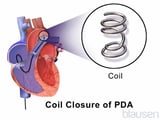 , or a combination of these tend to have less severe cyanosis, only symptoms and signs of middle failure (eg, tachypnea, dyspnea, tachycardia, diaphoresis, inability to proceeds weight) may develop during the starting time weeks of life.
Except for generalized cyanosis, physical test is rather unremarkable. Heart murmurs may be absent-minded unless associated anomalies are present. The 2nd middle audio (S2) is unmarried and loud.
-
Breast ten-ray and ECG
-
Echocardiography
Diagnosis of transposition of the great arteries is suspected clinically, supported by chest ten-ray and ECG, and established by 2-dimensional echocardiography with color flow and Doppler studies.
On chest x-ray, the cardiac shadow may accept the classic egg-on-a-string appearance with a narrow upper mediastinum. ECG shows right ventricular hypertrophy but may be normal for a neonate.
Cardiac catheterization is non normally necessary for diagnosis only may be done to enlarge the atrial advice (balloon atrial septostomy) or to farther elucidate complex coronary artery anatomy.
-
Prostaglandin E1 (PGE1) infusion
-
Sometimes balloon atrial septostomy
-
Surgical repair
Unless arterial oxygen saturation is only mildly decreased and the atrial communication is adequate, a PGE1 infusion may assistance by opening and maintaining patency of the ductus arteriosus; this infusion increases pulmonary claret flow, which may promote left-to-right atrial shunting, leading to improved systemic oxygenation. However, if the patent foramen ovale has a small opening, PGE1 may have the opposite outcome because the increased blood return to the left atrium may close the flap of the foramen ovale, leading to decreased mixing, along with summit of left atrial pressure and pulmonary edema. Also, opening the ductus may decrease systemic claret flow. Thus, PGE1 must exist used with caution and patients must be monitored closely.
Metabolic acidosis is treated with sodium bicarbonate. Pulmonary edema and respiratory failure may require mechanical ventilatory back up.
For severely hypoxemic neonates who do non immediately respond to PGE1 or who have a very restrictive foramen ovale, cardiac catheterization and balloon atrial septostomy (Rashkind process) can immediately improve systemic arterial oxygen saturation. A balloon-tipped catheter is advanced into the left atrium through the patent foramen ovale. The airship is inflated and abruptly withdrawn to the right atrium to enlarge the opening in the atrial septum. As an culling to taking the neonate to the catheterization laboratory, the septostomy procedure can be done at the bedside under echocardiographic guidance.
Definitive repair of D-TGA is the arterial switch (Jatene) operation, typically done during the first week of life. The proximal portions of the great arteries are transected, the coronary arteries are transplanted to the native pulmonary root, which will become the neoaortic root, the aorta is continued to the left ventricle, and the pulmonary artery is continued to the right ventricle. Survival rate after surgery is > 95%. An associated VSD should exist closed at the time of primary repair unless information technology is pocket-size and hemodynamically insignificant. Native pulmonic stenosis is problematic unless it is mild because pulmonic stenosis will effectively become aortic stenosis afterwards the arterial switch process. If pulmonic stenosis is moderate or severe, other surgical options may demand to be considered.
Because of the technical difficulties of transplanting the coronary arteries in neonates and infants, the arterial switch process could non be washed before the early on 1980s (1 Treatment references Transposition of the great arteries (in this example, dextro-transposition) occurs when the aorta arises directly from the right ventricle and the pulmonary avenue arises from the left ventricle... read more ) Prior to that era, patients with D-TGA were treated with an "atrial switch" performance, referred to equally either a Mustard or Senning procedure. This operation reconstructed the atrial septum and placed an intra-atrial baffle to divert the superior vena cava and inferior vena cava render to the left ventricle and the pulmonary venous return to the right ventricle. There are many adults with D-TGA born before 1980 who had this repair (2, 3 Treatment references Transposition of the groovy arteries (in this case, dextro-transposition) occurs when the aorta arises directly from the right ventricle and the pulmonary artery arises from the left ventricle... read more ). Still, these patients have a very high incidence of the long-term sequelae of dysfunction of the systemic correct ventricle, atrial arrhythmias, and baffle obstructions. Considering of those sequelae, the arterial switch procedure became the preferred approach once it was technically viable.
-
ane. Castaneda AR, Norwood WI, Jonas RA, et al: Transposition of the great arteries and intact ventricular septum: Anatomical repair in the neonate. Ann Thorac Surg 38:438–443, 1984. doi: 10.1016/s0003-4975(ten)64181-1
-
two. Kempny A, Dimopoulos Chiliad, Uebing A, et al: Outcome of cardiac surgery in patients with congenital heart disease in England between 1997 and 2015. PLoS 1 12(half-dozen):e0178963, 2017. doi:10.1371/journal.pone.01789631
-
3. Meadows AK: Transposition of the Great Arteries afterwards Mustard/Senning Repair. Adult Congenital Middle Association June 15, 2016. Accessed Nov 3, 2011. https://www.achaheart.org/your-heart/health-information/transposition-of-the-great-arteries-after-mustardsenning-repair/
-
In dextro-transposition of the great arteries (D-TGA), the aorta arises from the right ventricle and the pulmonary artery arises from the left ventricle, resulting in independent pulmonary and systemic circulations.
-
D-TGA is incompatible with life unless mixing of the circulations occurs through an atrial and/or ventricular septal opening, or a patent ductus.
-
Severe cyanosis occurs within hours of nativity, followed rapidly by metabolic acidosis; there are no murmurs unless other anomalies are nowadays.
-
Relieve cyanosis by giving prostaglandin E1 infusion to keep the ductus arteriosus open and sometimes past using a balloon catheter to enlarge the foramen ovale.
-
Do definitive surgical repair during the start week of life.
The following are some English language-language resource that may be useful. Delight note that The Manual is not responsible for the content of these resources.
Source: https://www.msdmanuals.com/professional/pediatrics/congenital-cardiovascular-anomalies/transposition-of-the-great-arteries-tga
0 Response to "How Many Days After Birth Does a Baby With Transposition of the Great Arteries Have Surgery"
Post a Comment